Welcome back to The Science of Leading, everyone. I’m Claire Monroe, and—as always—I’m here with Edwin Carrington.Today we’re talking about something that, honestly, most people have... feelings about: performance reviews.Edwin, do you remember your first one of those old-school, annual sit-downs?
I do. And, wow—yeah. It's been a while, but honestly... the model hasn’t evolved as much as we’d like to think.For decades, companies packed a whole year of feedback into one awkward meeting—maybe two, if you were lucky.The goal was alignment, sure. But more often than not? It left people frustrated or disengaged.A single session can't carry the weight of an entire year’s performance.
Totally. I used to just... dread it.We’d spend all year doing the work, and then—boom—fifteen minutes of vague commentary.No context, no clarity. Just this feeling of, “Okay, I guess that’s how I did?”At my last job, that finally broke for me. We were checking boxes, not growing people.And once I saw that... I couldn’t unsee it.
You’re not alone in that, Claire.And the data really backs it up.Organizations are shifting away from these static, once-a-year reviews toward something more fluid—more human.Think of it less like an event, more like a rhythm:Set goals early, track real-time progress, check in frequently, and give recognition as it’s earned—not months later.
Yeah... when you lay it out—plan, monitor, review, reward—it’s almost too logical.But so many teams never get past the “set-and-forget” phase.I’ve seen it—people flounder in silence for months, then get blindsided during review season.It’s like... we’re building in failure by staying silent.
Exactly. And it’s not just about catching problems earlier—though that matters.The continuous model actually builds stronger teams.Better engagement. Less turnover.And it gives managers a real chance to develop people, not just evaluate them.If a review ever feels like a surprise, that’s a sign something’s broken in the system.
And that word—“agility”—keeps coming up.Ongoing feedback lets teams adjust while the work is still happening.It’s like having headlights in a storm versus just reading the weather report afterward.
That’s a great way to put it.Continuous feedback creates visibility.And in today’s pace of change, that adaptability? It’s not optional—it’s survival.
Okay—so let’s get practical.What do high-performing teams actually do differently?Because I know everyone says “set clear goals,” but that’s... just the tip, right?
Right. It starts with clarity—but clarity plus collaboration.When people help shape the goals, they buy in.It’s not just a list handed down—it becomes a shared mission.Then you layer in real feedback—specific, useful, and timely.Not just, “good job,” but: “Here’s what worked—and why it mattered.”
That totally tracks. I remember reading about Tonkin + Taylor.They brought in regular one-on-ones and a tech system to support it, and suddenly... participation in reviews jumped to like 90%.But it wasn’t just more feedback—it actually felt fairer.People understood what success looked like, and how to grow toward it.
Exactly. Those regular check-ins create momentum.And when recognition becomes part of the system—not just a random “thanks”—you start seeing real behavior change.And it can’t just be about the top performers. Recognition has to be equitable, or you lose trust.
Okay, but let’s talk Bombas for a second.They had this mess of Google Docs, no one knew who owned what—classic chaos.Then they implemented a real performance platform, trained their managers, and suddenly everything clicked.Employees actually knew how to get promoted, what was expected, and reviews weren’t a black box anymore.That combo—clarity plus training—was huge.
Manager training is often the linchpin.Because when managers know how to coach—not just critique—everything shifts.Add in recognition, some autonomy... and you get loyalty.People stick around when they’re trusted and seen.
And the tech’s not magic—but it’s a multiplier, right?Tools like Culture Amp make the good practices easier.But they still need thoughtful people behind the scenes.Recognition doesn’t have to be cash. Sometimes just... a well-timed shoutout hits harder than a bonus.
Exactly.So when you add it all up—clear, collaborative goals... real-time feedback... thoughtful recognition... the right tools...You create a culture where people want to show up and solve problems.That’s miles away from the checkbox review systems of the past.
And if anyone’s listening like, “Uhhh, where do I even start?”Just—start small.One good weekly check-in can change the whole dynamic.Don’t wait for the perfect system.
It’s about layered momentum.You build better culture the same way you build anything: one solid habit at a time.
Okay, shifting gears—I want to touch on hiring for a second, because...Before I got into this stuff, I definitely thought good hiring was mostly gut instinct.You know—“Does this person vibe with us?”But apparently... that’s not exactly science.
A very common belief.But gut instinct—while tempting—is wildly unreliable.Unstructured interviews, where we just chat? Those have predictive validity of around 14–20%.That’s... basically flipping a coin.Charisma often overshadows actual capability.
So the answer’s not no instinct—it’s structure plus instinct?Like, same questions, clear rubrics, role-specific assessments?
Exactly. Structured interviews level the playing field.And when you add work samples or cognitive tests, you’re finally seeing how someone performs—not just how they present.Companies like Unilever and Chipotle are using AI tools to streamline this—and it’s working.Time-to-hire goes down. Diversity goes up.
But here’s my worry—Doesn’t automation risk locking in the same old biases if we’re not careful?Like, the tool’s only as fair as the data it’s fed, right?
That’s an essential point.Which is why human oversight has to stay in the loop.The best companies audit their systems regularly, use frameworks like the Rooney Rule, and track demographic data to spot bias in real time.Tech can help—but only when paired with ethical leadership.
So... use data like a compass—not a driverless car.Leaders still have to steer.And that means transparency. Fairness. Actual accountability.
Exactly.The goal is never perfection.It’s clarity, consistency, and learning with every cycle.That mindset—that’s what transforms hiring and performance.
Honestly... that’s the big takeaway.Whether we’re talking feedback, hiring, or recognition—this stuff builds over time.It’s not about nailing every step.It’s about choosing to get better, one layer at a time.
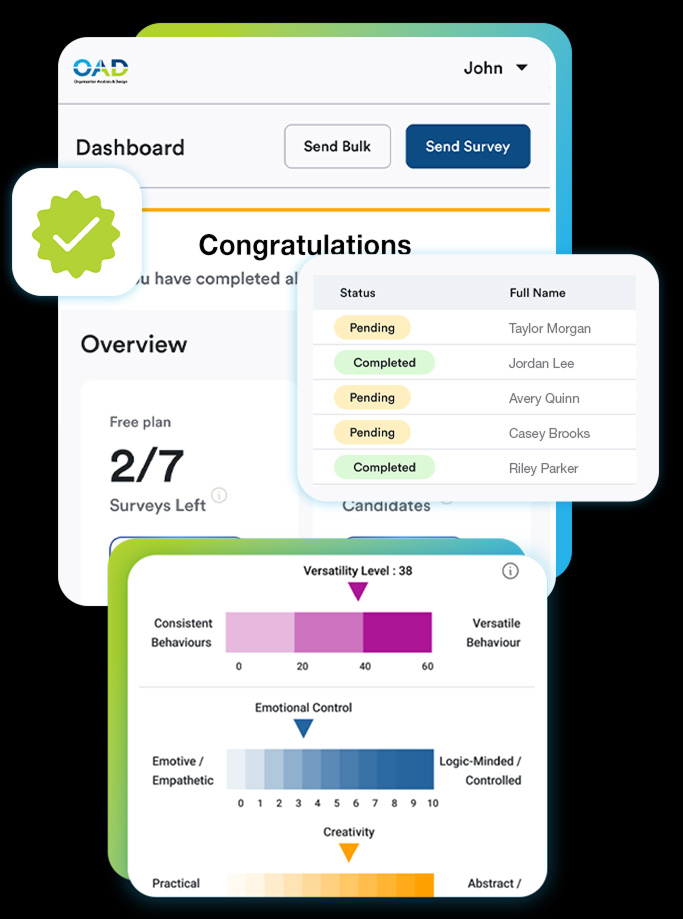
And if you’re wondering how to put this into action...You can test out OAD’s tools—like behavioral assessments—for free at o-a-d dot a-i.They make it easier to spot team fit, align goals, and simplify those people decisions that matter most.
And if you haven’t yet—go check out our earlier episodes on motivation, hiring bias, or AI in the workplace.We’ve covered a lot—and we’re just getting started.
Thanks for listening, everyone.Stay curious, keep leading... and always question the default.
See you next time!