Welcome back to The Science of Leading! I'm Claire Monroe, here with the ever-wise Edwin Carrington. Today we're diving into something that's—honestly—changed the way I think about leadership development: actually using real data to move the needle.Because Edwin—I keep seeing companies throw so much money at leadership programs, but... nothing really sticks. Are we seriously that bad at trusting our gut?
Intuition isn’t worthless, Claire. But when it comes to leadership development? Relying only on gut instinct can be an expensive mistake.There’s a study by Dr. Llewellyn van Zyl that found 70 percent of employee engagement is tied to leadership quality. Seventy. Yet most companies still roll out one-size-fits-all programs—nothing customized, no connection to actual performance data.The result? Activity without progress. You’re moving, but you’re not going anywhere.
That hits hard—because yeah, I’ve seen it. Same workshops, same frameworks… people nodding along, and then nothing changes.So, if I’m a leader who’s, like, done with wasting time—where do I start? What does using data actually look like in this?
It starts with a leadership capability model—but not some templated theory. This one’s built from data inside your organization.You define what excellent leadership looks like—based on evidence. That means pulling insights from past performance, assessments, peer reviews. And then you identify which specific competencies actually predict success.You’re not guessing anymore. You’re aligning leadership with business outcomes—and you’ve got the numbers to back it.
So no more stealing Apple’s playbook and pretending it’ll work at your logistics company?
Exactly. After that, you build a roadmap. Not just “here’s a list of soft skills,” but a real map—using predictive models to connect capabilities with results.When you track things like job demands, resource availability, motivation, and key outcomes—you begin to see which gaps actually hurt performance. Then you create hyper-personalized plans.It’s leadership development that fits the person, the role, and the business mission—not whatever’s trending on LinkedIn this week.
That actually makes sense. It sounds more complex—but weirdly, it’s clearer. Like, if you’re fixing a car, you want the right tools, not just a bigger toolbox.But what actually surprises people when they see this data for the first time?
Almost always? Blind spots. Either something they thought was a strength turns out to be… not. Or there’s potential they never realized they had.But here’s the key—it’s not about judgment. It’s about clarity.That’s when people shift from being passive learners to active participants. Because now, development has purpose. It’s targeted. It’s personal.
And that’s what finally creates momentum. Because when you’re dealing with reality—you’re not just guessing anymore. You’re not throwing darts with your eyes closed.
Right. The whole conversation changes.Leadership development becomes an ongoing process—grounded in evidence, tied directly to impact.You’re not replacing intuition—you’re informing it, sharpening it.
That leads perfectly into what we’re talking about next—hiring.We’ve mentioned this before, but it keeps coming up: the skills companies need are changing fast. What made someone a perfect fit last year might be totally irrelevant next year.How are companies supposed to keep up with that kind of change?
That’s the challenge. Work is evolving—partly because of tech like AI and automation, but also global shifts like sustainability and remote structures.Degrees and job titles just don’t cut it anymore. More companies are flipping their hiring model—from credentials to capabilities.What can this person actually do? And more importantly—can they learn fast?
So less “What school did you go to?” and more “Show me how you think.”Are there ways to spot that learning ability early?
Yes. The first step is scanning your own industry’s trajectory. Use trend reports, forecasting tools, even your own internal shifts.Then bring in platforms like GoPerfect. These tools don’t just highlight current skills—they spot growth capacity.And here’s the bigger move: ditch rigid job descriptions. Instead, build developmental pipelines.Hire people for how they’ll grow—not just how they look on paper today.
That reminds me—you mentioned a tech company you worked with that did this. What changed for them?
They redefined their approach completely. Instead of filtering for degrees and checkboxes, they started tracking adaptability and collaborative skill.They mapped emerging needs regularly and invested in cross-training.So when the market shifted, they didn’t panic. They had people ready to step into new roles.Adaptability became part of the culture—not a last-minute scramble.
That also makes me think about inclusion. Because if your tools are biased, you’re probably screening out amazing people without even realizing it.
Absolutely. That’s where platforms like ByeBias come in. They anonymize applications—so you focus on ability and growth potential, not unconscious bias.When you mix inclusive hiring with a learning-focused culture, your teams become more resilient—and far more innovative.
So it’s not people versus tech—it’s people with tech.The AI helps you spot patterns. But humans still build the trust and culture.
Exactly. Tech speeds up the process. But humans still make the decisions that matter.
Okay, last topic—and I love this one. Continuous learning.Let’s be honest—no one’s really “future-proof” unless they’re learning all the time.Edwin, what strategies have you seen actually work—like, companies that live this idea?
The most effective ones make learning part of the workflow. Not a bonus. Not a box to check.They build a growth mindset into daily life—promoting resilience, experimentation, and progress over perfection.Microlearning is a great tactic. Short, focused modules that fit busy schedules and keep people leveling up without disruption.
That was huge for me early on. I joined this scrappy peer-led group at my first job. No one was “senior”—we just tackled a wild project together.And I swear, I learned more in that chaos than I did in any course. It was the collaboration that made it stick.
Exactly. Collaborative learning mirrors how we solve real problems—across departments, with different perspectives.That’s why team projects, mentorship, and peer teaching are so effective.And with today’s tools—LMS platforms, just-in-time content, even VR—you can personalize learning at scale.The key is integration. Learning isn’t something you add after the work. It is the work.
Yeah, like… performance reviews that include learning goals. Or regular one-on-ones that actually ask, “What are you working on learning right now?”And then—you track it. You measure if people are actually getting better, or just… busier.
Right. The ROI isn’t about how many courses get completed. It’s whether those skills drive performance, retention, innovation.And none of this works without leadership buy-in. If execs treat learning like a side project, it’ll never scale.
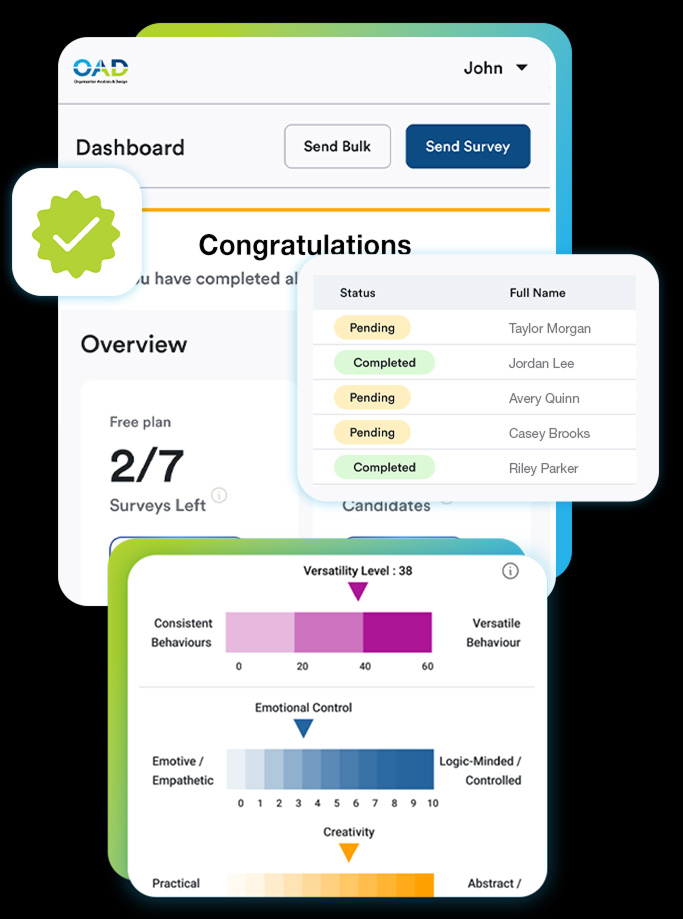
I love that. And hey—if you’re listening and wondering how to start?You can test out OAD’s tools—like behavioral assessments—for free at o-a-d-dot-a-i.It’s honestly such a smart way to reduce friction in hiring, and help people grow in the right roles.
Because that’s where the real edge is.When learning, hiring, and leadership all align—that’s when companies stop playing catch-up… and start leading from the front.
Couldn’t have said it better.Thanks for being here, Edwin. And thanks to all of you listening to The Science of Leading.Stay curious, stay connected—and we’ll see you next time.
Until then, Claire. Take care, everyone.